Claude vs ChatGPT vs Perplexity vs Gemini: Which AI Is Best for Business Research?
AI tools for business research are transforming how companies analyse markets, competitors, and opportunities.
Most businesses are using AI for research — but getting poor results.
Not because AI doesn’t work, but because they’re using the wrong tool at the wrong stage.
But most business owners are asking the wrong question.
It’s not:
“Which AI is best?”
It’s:
“Which AI should I use at each stage of research?”
Because these tools are not interchangeable — they are designed for different types of thinking.
Some excel at:
- Discovering real-time information
- Analysing complex data
- Turning insights into strategy and execution
In this guide, we break down exactly how each tool works, where it fits in a business research workflow, and how to use them together to make better decisions, faster.
The businesses that win with AI are not using better tools — they are using the right tools at the right time.
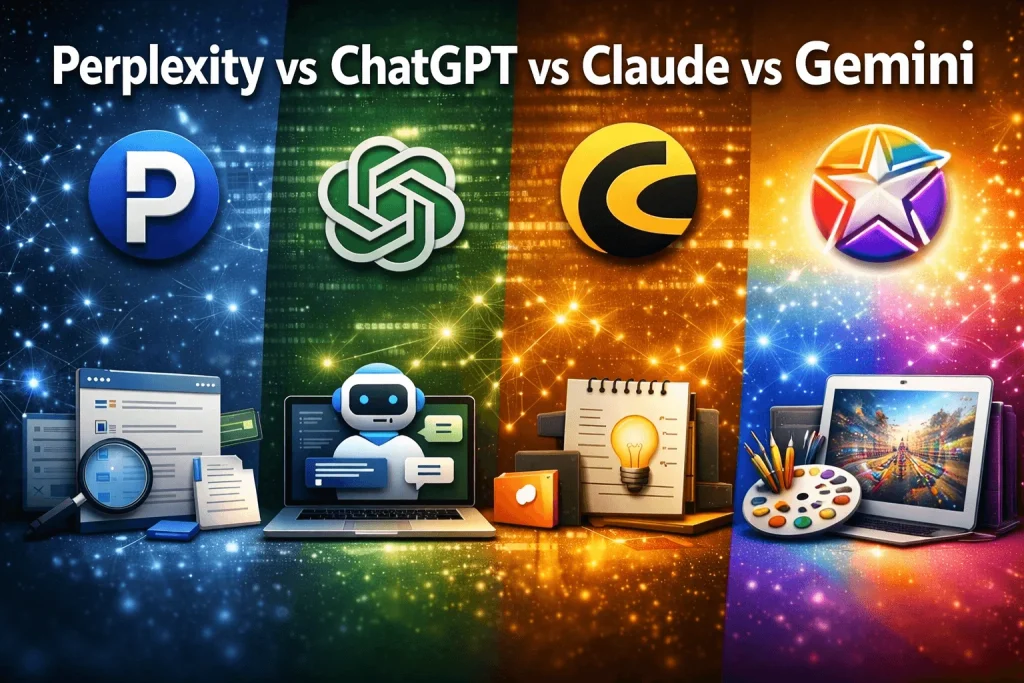
Comparison: Claude vs ChatGPT vs Perplexity vs Gemini
These tools are not competitors — they are complementary.
What Businesses Actually Need AI Research For
In practice, business research is not one task — it’s a combination of activities:
- Identifying competitors and analysing their positioning
- Understanding market trends and opportunities
- Discovering customer pain points and language
- Evaluating SEO opportunities and content gaps
- Turning raw information into a clear strategy
This is where AI becomes powerful.
Used correctly, AI functions as a:
- Research assistant
- Analyst
- Strategist
—all in one workflow.
Claude: The Strategic Analyst
Claude is best understood as a thinking tool.
It excels when the challenge is not finding information — but making sense of it.
Where Claude Excels
- Processing large volumes of information
- Identifying patterns and insights
- Producing structured strategic outputs
- Summarising complex documents
High-Value Business Use Cases
- Analysing competitor websites and messaging
- Synthesising market research reports
- Reviewing long PDFs or transcripts
- Creating strategy memos and frameworks
A business researching competitors can input multiple sources and ask:
Claude turns scattered information into clear strategic insight.
ChatGPT: The Execution Engine
ChatGPT is the most versatile tool — but its real strength is execution.
It takes insights and turns them into usable outputs.
Where ChatGPT Excels
- Structuring ideas into frameworks
- Creating marketing strategies and plans
- Generating content and campaigns
- Building repeatable workflows
High-Value Business Use Cases
- SEO research and content planning
- Marketing strategy development
- Content calendars and messaging
- Campaign ideation
After completing research:
ChatGPT transforms research into actionable deliverables.
Perplexity: The Research Engine
Perplexity is the closest thing to a true AI research assistant.
It is designed for discovering and validating information in real time.
Where Perplexity Excels
- Real-time web research
- Providing cited, verifiable sources
- Summarising current information
- Identifying trends and competitors
High-Value Business Use Cases
- Market research and trend analysis
- Competitor discovery
- Gathering statistics and data
- Verifying claims
“What are the top competitors in [industry]? Include sources.”
Gemini: The Integration engine
Gemini is the closest thing to a truly integrated AI assistant.
It is designed for connecting tools and information seamlessly in real time.
Where Gemini Excels
- Research with Google Integration
- Youtube/video analysis
- Anything in Google Workspace
- Multimodal Tasks
High-Value Business Use Cases
- Connecting data across tools for insights
- Multimodal content creation and analysis
- Gathering statistics and data
- Verifying claims
“What’s happening across my emails, docs, and meetings today? Summarise and take action.”
The Reality: No Single Tool Is “Best”
There is no single “best AI tool for research.” Each tool solves a different part of the problem:
The Upward AI Research Framework
At Upward Consulting, we use AI as a system — not a single tool. The AI Research Stack
Perplexity — Discovery
Claude — Analysis
ChatGPT — Execution
Gemini — Integration
Perplexity
finds information
Claude
analyse information
Chat GPT
applies information
Gemini
connects info
Real-World Application
Example: SEO Strategy for a Service Business A service-based business used this workflow to build a content strategy:
- Perplexity → Identified trending search topics and competitor content
- Claude → Analysed gaps in competitor messaging
- ChatGPT → Generated a 3-month SEO content plan
- Gemini → Integrated plan, tracked performance, and optimised execution
Result: A complete strategy built in hours instead of weeks.
Limitations of AI in Business Research
While powerful, AI is not perfect.
Common Limitations
- Inaccurate or “hallucinated” information
- Lack of real-world business context
- Dependence on existing data
Best Practice
Use AI to:
- Accelerate research
- Structure thinking
- Validate key insights
- Apply human judgement
Which AI Tool Should You Choose?
If you had to choose just one:
- Best for research → Perplexity
- Best for analysis → Claude
- Best for execution → ChatGPT
- Best for integration → Gemini
But the real advantage comes from using all four together.
Choosing the right AI tools for business research is key to building a scalable strategy.
Final Thoughts
Claude, ChatGPT, Gemini and Perplexity are not competing tools.
They represent following stages of modern business research:
- Discovery
- Analysis
- Execution
- Integration
Businesses that combine these tools effectively will:
- Move faster
- Make better decisions
- Outperform competitors